 YundaDesk
Deactivate, disconnect, uninstall, and use privacy tools
Safely manage the YundaDesk plugin lifecycle, WordPress privacy requests, reauthorization, and common failures.
Updated 2026-09-07
A white-label chat bubble for your site
Send and receive through your own system
Bring customer email into one inbox
 WhatsApp
Connect WhatsApp Business to serve customers
 Messenger
Connect Facebook Pages and handle messages
 Instagram DM
Receive and reply to Instagram DMs
 LINE
LINEConnect a LINE official account to serve customers
 Telegram
Connect a Telegram bot for customer messages
 Zalo OA
Connect a Zalo Official Account
 YouTube
Receive and reply to comments
 WeChat Customer Service
Connect official enterprise customer service accounts
Add MessengerAuthorize securely with Facebook
No App Secret, verify token, or Page token to copy. YundaDesk lists manageable Pages and checks the connection automatically.
Authorize myself
The current staff member manages the Facebook Page.
Connect with FacebookSelect a Facebook Page
Complete authorization in the new tab. It closes automatically and returns the result to this workspace.
Acme SupportPage ID · 104823750001Messaging permission availableYundaDesk subscribes messages, postbacks, delivery, and read events, then runs a live connection check.
Finish connectionChoose your email provider
 GmailConnect a Gmail or Google Workspace mailbox
 Microsoft OutlookConnect an Outlook or Microsoft 365 mailboxChannel maintenance
Mail settings are filled in from your address. You can edit them.
No preset matched. You can enter the mail settings manually in the next step.
Advanced settings
imap.yourbrand.com · 993smtp.yourbrand.com · 465Save disabled first, test IMAP and SMTP, and enable the channel only after both pass.
Connect & enableSelect customer service accounts
Each selected account becomes an independent channel that is enabled immediately, with AI replies off by default.
DEMO_REDACTED_IDENTITY_KEY
When off, customers wait for a team member.
View the customer identity signing key in channel settings. Your website backend signs an HS256 JWT for the current signed-in user. Keep the key on your backend only.
Include user_id, widget_key, iat, and exp; set aud to yundadesk-widget-identity. Use Unix seconds for timestamps. A 5-minute token lifetime is recommended.
Run this code after website login. Replace /support/identity with your website endpoint, which returns { token }.
const loginSupport = () => YundaDesk.login({
  getToken: () => fetch('/support/identity', { credentials: 'same-origin' })
    .then(response => {
      if (!response.ok) throw new Error('Identity request failed');
      return response.json();
    })
    .then(({ token }) => token),
});
if (window.YundaDesk?.login) loginSupport();
else window.addEventListener('yundadesk:ready', loginSupport, { once: true });
Call YundaDesk.logout() before website logout or account switching to clear the customer identity in the Widget.
Optional fields: name, email, phone, avatar, locale. custom_attributes accepts enabled customer custom fields only; use their field keys.
<script src="https://cdn.yundadesk.com/widget.js" data-yd-key="yd_widget_main" async></script>- Widget Key
- yd_widget_main
- Script URL
- https://cdn.yundadesk.com/widget.js
- Direct link
- https://cdn.yundadesk.com/?widget_key=yd_widget_main
Telegram bot setup guide
Three steps: ① find @BotFather to create a bot and get the token → ② paste the token on the left → ③ save and enable; the system receives new messages automatically.
1. Create a Telegram bot
- In Telegram, search for @BotFather and open the chat.
- Send /newbot to create a new bot.
- Follow the prompts to set a display name and username (ending in _bot).
- Copy the bot token returned by BotFather.
2. Enter the token on the left and enable
- Paste the token into “Bot Token” on the left.
- Click “Save” at the top, then “Enable”.
- Click “Test connection” to verify the bot token works.
3. Test the bot
- Search for the bot username in Telegram and start a chat.
- Send any message and AI / an agent will reply automatically.
- See Telegram Bot API docs.
Inbound webhook URL
Copy this full URL into the webhook settings of the third-party console so customer messages reach YundaDesk.
https://api.example.invalid/hooks/channel/line/demo-onlyCopyLINE Official Account setup guide
1. Enable the Messaging API
- Sign in to LINE Official Account Manager, select the official account to connect, and enable the Messaging API under Settings > Messaging API.
- Copy the Channel ID and Channel Secret from the same page.
2. Save and enable in YundaDesk
- Enter the Channel ID and Channel Secret on the left and save. YundaDesk verifies them with LINE and then shows the matching LINE Official Account.
- Click Enable so the channel starts receiving messages.
3. Set up the webhook and test
- Copy the inbound webhook URL above, paste it into Webhook URL under Settings > Messaging API in LINE Official Account Manager, and save.
- Turn on Webhook under Settings > Response settings. We also recommend turning off auto-response and greeting messages so customers don't get duplicate replies.
- Back in YundaDesk, click Test connection. Once it passes, send a message to the official account from LINE and check that it appears in Chat.
The channel credential has expired. Please reauthorize and try again.
Connection failedBot receiving conflict
Bot webhook is active
Telegram bot setup guide
Three steps: ① find @BotFather to create a bot and get the token → ② paste the token on the left → ③ save and enable; the system receives new messages automatically.
1. Create a Telegram bot
- In Telegram, search for @BotFather and open the chat.
- Send /newbot to create a new bot.
- Follow the prompts to set a display name and username (ending in _bot).
- Copy the bot token returned by BotFather.
2. Enter the token on the left and enable
- Paste the token into “Bot Token” on the left.
- Click “Save” at the top, then “Enable”.
- Click “Test connection” to verify the bot token works.
3. Test the bot
Callbacks go through YundaDesk fixed secure egress. If your receiver restricts sources, add the egress IPs to its allowlist.
Callbacks go through YundaDesk fixed secure egress. Allowlist these IPs: 203.0.113.10, 203.0.113.11
View allowlist IPsCustom API setup guide
1. Create a Custom API channel
- Enter the channel name and “your system callback URL” on the left.
- After saving, the system generates a connection key and signing key to confirm message ownership and request authenticity.
- (Optional) Add an IP allowlist to restrict sources.
2. Forward customer messages to YundaDesk
- POST messages as JSON to the webhook URL above.
- Include the connection key, timestamp, signature, and idempotency key in the headers.
- A 200 response means received; other statuses are treated as failures and retried.
3. Receive reply pushes
- Once enabled, YundaDesk pushes agent / AI replies to the “your system callback URL” you entered on the left.
- Deduplicate by external message ID for idempotency.
| Event | Time | Status |
|---|---|---|
| message.created | 2026/07/28 14:20 | Delivered |
| message.created | 2026/07/28 14:06 | Timeout · retrying |
| conversation.assigned | 2026/07/28 13:41 | Signature rejected |
Publish a public help center so customers can find answers on their own and cut repeat questions.
Install one YundaDesk plugin to add live chat, AI support, and a secure Widget binding to a WordPress site.
Use the same YundaDesk WordPress plugin; after WooCommerce is detected and authorized read-only, sync store, customer, order, product, and current cart context.
Connect SHOPLINE to sync orders, customers, and products, and enable YundaDesk storefront chat in the theme when needed.
Connect a BigCommerce store, sync customer order context, and show recent orders in the workspace sidebar.
Can’t find what you need?
Store actions awaiting approval
Review the store-generated preview before approval. Approval triggers one controlled commit; changed inputs require a new preview.
Create recovery discount · DEMO-SAVE10Live store preview · 10% · Demo Yundastore
The store has not returned a definitive result. Do not submit it again; this control only queries the result and never repeats the action.
Check resultRequest
Inputs
Outputs
Usage rules
☑ Require verified customer identity
Only customers verified in the current conversation can use this function. Otherwise, execution pauses.
Request
Enable only if this POST endpoint queries data without changing it.
Inputs
Parameter settings
Sent as a JSON body field. Enter valid JSON and describe its structure in the parameter description.
Request
Inputs
Usage rules
Result verification (optional)Use the API response by default. Add a read-only check if further verification is needed.
View tests and Agent calls for this function.
Select tools for future use. Saving does not grant Agent execution permission.
Credentials are stored securely and never displayed.
Connectors
Choose the functions this Agent can use. Calls follow function settings and business rules in skills.
Search connections or functions
☑ lookup_order
☐ lookup_order Select the output fields available to the Agent first.
☐ lookup_refund Configuration changed. Select again to authorize.
| Customer | Channel / source | Location / language | Tags | Last interaction | Added | |
|---|---|---|---|---|---|---|
| MMaria Garciamaria@example.com | Web Widget | 🇪🇸 SpainSpanish | 05/22/2026 | 05/18/2026 | ||
| LLukas Schneider+49 30 123456 | Telegram | 🇩🇪 GermanyGerman | 05/20/2026 | 05/16/2026 | ||
| AAna Silva | 🇧🇷 BrazilPortuguese | 05/22/2026 | 05/16/2026 |
| Agent | Role | Reception channels | Readiness | Status |
|---|---|---|---|---|
| AAlexManaged AI | General reception | Website · WhatsApp | Ready | Running |
| NNovaManaged AI | General reception | Messenger | Ready | Running |
| SSamExternal AI | General reception | — | Setup incomplete | Draft |
Choose which tools and actions this Agent may call. These switches never replace runtime authorization, approval, or audit.
When a customer asks where an order is, look it up first, then reply in brand voice.
Yuna finds opportunities in real customer conversations. Nothing updates knowledge or skills until you approve it.
↳Yes, Brazil shipping usually takes 7-12 business days.
Human answered·1↳Auto-detect VIP customers · Detect VIP status and prompt agents to follow up first.
Human answered·1·L2 risk↳Opened items can be returned within 30 days if the package is complete.
Human answered·1↳If DHL has not updated for over 72 hours, check the order first, then hand off for compensation review.
You corrected·1·L2 riskManage how Agents handle customer-initiated requests. Skills affect live conversations only after simulation and publishing.
2 items| Skill | Status | Use case | Last 7 days | Actions |
|---|---|---|---|---|
| Order tracking lookupWhen a customer asks where an order is, look it up first, then reply in brand voice. | Active | Lookup | Used 12 times92% success | |
| Auto-detect VIP customersDetect VIP status and prompt agents to follow up first. | Testing | Triage | Not used yet |
Conversation volume, response efficiency, and AI service quality at a glance.
Last 7 daysLast 30 daysLast 90 days| Dimension | Conversations | Messages | Avg. first response | Resolved | Share |
|---|---|---|---|---|---|
| Web Widget | 712 | 4,128 | 38s | 496 | 60% |
| Telegram | 284 | 1,620 | 45s | 219 | 24% |
| 198 | 980 | 3m 12s | 146 | 17% |
Language & timezone
Local time 16:30 · UTC+00:00
Appearance
Account actions
Danger zone
The workspace is disabled immediately. Ops can restore it within 2 hours; after that it is permanently deleted.
Delete workspaceAgent identity
PNG, JPG, or WebP up to 5 MB
Project identity
Reply entries
Create your first quick reply; agents can invoke it by typing /.
New quick replyBrand configuration
256×256 PNG / SVG recommended; you can crop to a square after uploading
Notification permission
Notification settings
Notification scenes
Test notification
Send testSend a test notification to verify everything works.
Send key
Conversation handling
Translation settings
Create a subscription to push events to your own backend for integration or data archiving.
AI Credit
Buy AI CreditCurrent cycle resets on 09/30/2026
Plan quota 10,000
Knowledge import, parsing, and offline compilation do not consume AI Credit
Record list

Subscription active
Current cycle ends 09/30/2026.
AI Credit
Pro and Enterprise support connecting your own AI in Agents. External AI has no additional charge and uses no YundaDesk AI Credits. Third-party AI fees are paid separately; managed AI continues to use Credits.
2,400 used
Current cycle resets on 09/30/2026
1,000 used
Other usage
Seats used
3Channels connected
2Yuna requests completed this month
42New conversations this month
128Messages this month
580Documents indexed
12Deliveries this month
0These workspace-wide rules apply to proactive customer outreach. They do not affect internal reports sent to you.
Cooldown is 24 hours per customer; at most 2 touches in 7 days.
Quiet hours
Contact frequency
Team members
| Member | Role | Status & skills | Last sign-in | Last used | Actions |
|---|---|---|---|---|---|
| ACAnna ChenMeanna@yundadesk.testOnline | Admin | ActiveEnglishRefundsMax 12 concurrent | Today, 09:42 | 2 min ago | |
| LWLeo Wangleo@yundadesk.testOnline | Agent | ActiveEnglishAfter-salesMax 6 concurrent | Yesterday, 18:20 | Today, 10:06 | |
| MGMaria Garciamaria@yundadesk.testOffline | Agent | PendingSpanishPre-salesMax 8 concurrent | — | — |
Could not establish a secure connection. If the site is HTTP-only, crawl it again with an http:// URL
| Document | Size | Tags | Updated | Status | Actions |
|---|---|---|---|---|---|
| demo-owner/support-guide 2 | — | — | Updated Jun 3, 2026, 4:00 PM | Healthy |
| Document | Size | Tags | Updated | Status | Actions |
|---|---|---|---|---|---|
| https://tgo.ai/help/shipping· 47 pages | — | — | — | Searchable | ⋯ |
| Support knowledge · Notion · 128 docs | — | — | Last synced 2026/07/29 03:10 | Retrievable | ⋯ |
| Brazil shipping timelines | — | Updated Jun 3, 2026, 4:00 PM | Searchable | ⋯ | |
| EU customs & duties | — | Updated Jun 4, 2026, 2:30 PM | Indexing | ⋯ | |
| 30-day refund policy | — | Updated Jun 2, 2026, 8:00 PM | Searchable | ⋯ |
| Document | Size | Tags | Updated | Status | Actions |
|---|---|---|---|---|---|
| Brazil shipping timelineshttps://tgo.ai/help/shipping/brazil | — | shipping | 10/04 | Searchable | ⋯ |
| Load more | |||||
| Document | Size | Tags | Updated | Status | Actions |
|---|---|---|---|---|---|
| Brazil shipping policy | — | Updated Jun 3, 2026, 4:05 PM | Waiting to index | ⋯ | |
| EU customs & duties | — | Updated Jun 4, 2026, 2:30 PM | Indexing | ⋯ | |
| Brazil shipping timelines | — | Updated Jun 3, 2026, 4:00 PM | Searchable | ⋯ | |
| Import restrictions PDFError: The PDF contains no readable text | — | Updated Jun 7, 2026, 4:30 PM | Indexing failed | ⋯ |
| Document | Size | Tags | Updated | Status | Actions |
|---|---|---|---|---|---|
| https://tgo.ai/help/shipping · 0 pagesProcessed 3 / Discovered 50 pages | — | — | Crawl job running | Crawling | ⋯ |
| https://tgo.ai/help/shipping · 47 pagesLast sync succeeded · 47 pages | — | — | Last synced Jun 20, 2026, 4:00 PM | Searchable | ⋯ |
| Customer question | Standard answer | Source | Tags | Status | Actions |
|---|---|---|---|---|---|
| Do you ship to Brazil? | Shipping to Brazil usually takes 7-12 business days. | Compiled · Brazil shipping policy | Enabled | ⋯ |
Stop syncing and keep this source's 2 documents. Existing content can still be used in AI replies.
Stop syncing and move this source's 2 documents to Trash. They will no longer be used in AI replies. The remote repository and other sources will not be changed.
Separate with commas; * and ** are supported. Exclusions win. Select at least one file type.
2 files to import
- help/shipping.md
- help/returns.md
No files match. Adjust the selection or filters and preview again.
Connect Notion, choose the pages to sync, and import documents automatically.
Connect NotionNotion is not connected yet
Test the saved reception setup as a visitor without creating a real conversation.
What needs my attention today?
Three things: 2 learning suggestions to review and 1 outreach waiting for your confirmation. Yesterday's auto-resolution hit 84%, up 3 points.
Bring the same Yuna conversation to the creator or admin's phone. Feishu, Telegram Bot, and WeChat messages stay in the original Yuna thread.
 FeishuSend and receive Yuna messages with a Feishu bot.Not connected
Good for teams that already work in Feishu.
ConnectTelegram BotSend and receive Yuna messages with a Telegram Bot.Not connectedGood for cross-border teams that work in Telegram.
ConnectGood for teams that handle work from WeChat.
ConnectFeishuSend and receive Yuna messages with a Feishu bot.ConnectedLast received—
Last sent—
Telegram BotSend and receive Yuna messages with a Telegram Bot.Not connectedGood for cross-border teams that work in Telegram.
ConnectGood for teams that handle work from WeChat.
ConnectWaiting for confirmationValid until 07/04/2026, 12:10
Support Agent · External AI
External setup
Edit external AI- Connection
- OpenAI Chat Completions
- Endpoint
- https://api.example.com/v1
- Key
- Configured · DEMO-REDACTED
Maintain persona, knowledge, and reply logic in your external service. Use “Edit external AI” to update the endpoint or key, and the preview on the right to test replies.
External AI only handles auto-replies. It is not written into YundaDesk AI learnings and does not generate AI skills.
Your plan does not include external AI, so external reception is paused and its configuration is retained. Upgrade to Pro to resume, or create a managed Agent and reassign its channels.
Choose which tools and actions this Agent may call. These switches never replace runtime authorization, approval, or audit.
When a customer asks where an order is, look it up first, then reply in brand voice.
Both visitors and agents will see this name
Online queue, no-agents-online, and agent-joined notices apply only to messaging channels. Email channels do not send these three reception messages.
This Agent can only search explicitly selected content. Its reception focus never grants knowledge access.
Knowledge searchCould not generate suggested questions. Please regenerate them.
Selected channels are handled by the current AI. Channels not selected here will not use AI replies.
SelectTelegramTroubleshooting, disconnect, and privacy actions always target one explicit site binding and never cross sites.
Deactivation, disconnection, and deletion have different effects. Choose the action that matches whether you intend to pause the plugin, move the site, or remove the integration.
Understand each lifecycle action#
| Action | WordPress Widget | WooCommerce enhancement | Local connection information |
|---|---|---|---|
| Deactivate YundaDesk | Stops loading | Pauses synchronization and YundaDesk-created events | Kept for recovery |
| Disconnect site | Stops loading | Pauses and revokes the YundaDesk connection | Removed after the disconnect completes |
| Delete the plugin | Stops loading | Removes plugin-owned event configuration | Saved plugin connection settings and temporary data are removed |
| Deactivate WooCommerce only | Continues working | Pauses | WordPress connection remains |
To disconnect, open Settings → YundaDesk, select the disconnect action, and wait for confirmation before deleting the plugin. If WooCommerce was authorized, also open WooCommerce → Settings → Advanced → REST API and remove the YundaDesk key after disconnection.
Disconnecting one site does not disconnect other WordPress sites in the same YundaDesk workspace.
Disconnect in WordPress in YundaDesk's site list opens WordPress Admin; it is not a direct platform disconnect. While disconnection is incomplete, the site remains visible as Disconnecting. Wait for completion, or return to WordPress to retry if it remains pending. Once complete, the site leaves the everyday management list without deleting conversation history. Temporarily unreachable, deactivated, or authorization-failed current sites remain visible and must not be treated as disconnected.
After all sites finish disconnecting, the app cards return to their original official installation entry without an installed status. When available, Install on WordPress opens the WordPress.org plugin directory directly in a new tab, not a connection-instructions dialog. You do not need to reinstall an existing plugin; you can also reconnect directly from Settings → YundaDesk in the intended WordPress Admin.
Export personal data#
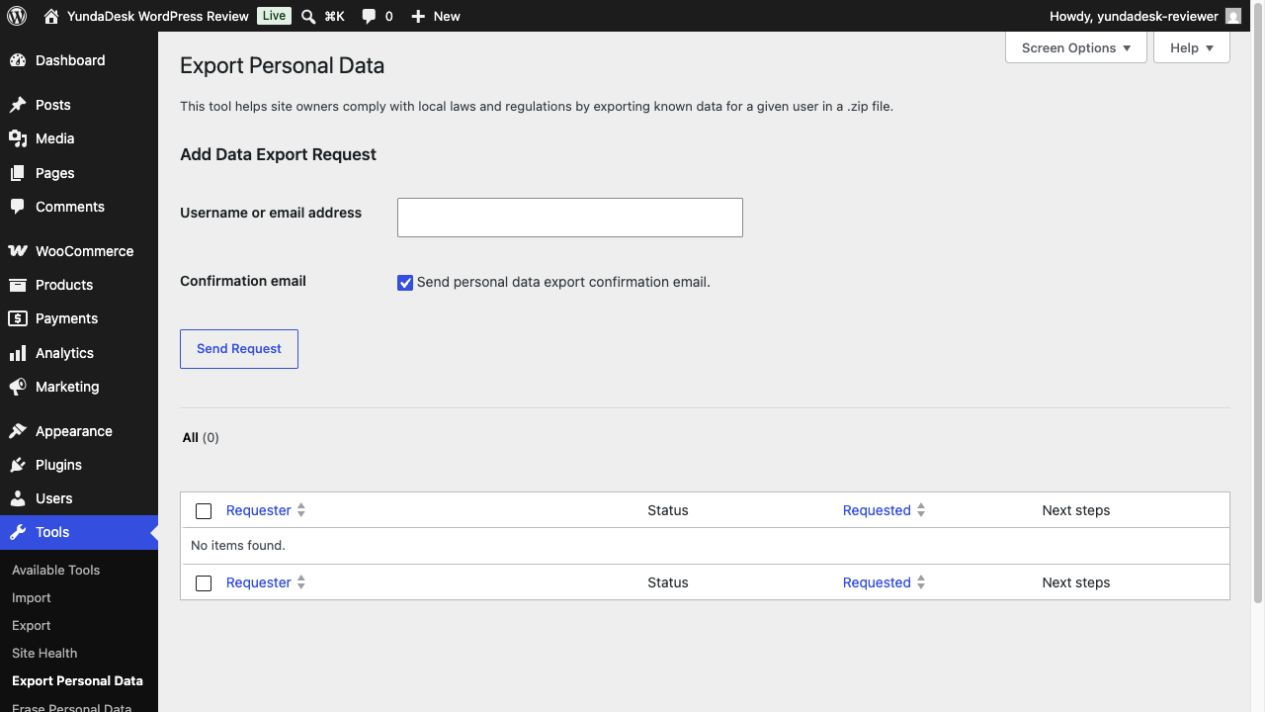
- In WordPress Admin, open Tools → Export Personal Data.
- Enter the verified requester's email address.
- Send or confirm the request using the normal WordPress process.
- Generate the export after WordPress marks the request confirmed.
The YundaDesk exporter returns support data associated with the current connected site. Data that belongs independently to another connected site is not included.
Erase personal data#
- Open Tools → Erase Personal Data.
- Enter the verified requester's email address.
- Complete the normal WordPress confirmation process.
- Run erasure and review the result from every participating plugin.
The YundaDesk eraser applies only to the current site's connection. A remote deletion that cannot finish is reported as incomplete so the administrator can retry it. Site administrators must verify the requester and decide whether any data must be retained for legal reasons.
Move the site to another domain#
After WordPress uses its new website address, open Settings → YundaDesk at that address. If it still shows Connected, disconnect the current site and wait for confirmation, then select Connect YundaDesk. On Confirm the site address change, check the previous address, current address and chat channel, select Update and connect, then Return to WordPress. The original channel and past conversations are kept; you do not need another channel.
If the previous connection is already disconnected, follow Reconnect or restore a previous site to choose the correct target. Do not rely on a matching address alone, reuse old pairing links, or copy another site's connection settings.
Afterward, verify a new storefront message. If you use WooCommerce, separately renew read-only access and check an order from the current store.
Troubleshooting#
The Widget does not appear#
- Confirm that the site says Connected under Settings → YundaDesk.
- Test a public page rather than WordPress Admin, a login page, a feed, or a REST response.
- Clear page and CDN caches after connecting.
- Confirm that the site's content security policy allows the YundaDesk API and Widget loader listed in Data and permissions.
WooCommerce is not detected#
- Confirm that WooCommerce is active on the same WordPress site.
- Upgrade WooCommerce to version 8.2 or newer.
- Reload Settings → YundaDesk.
Reauthorization is required#
Select the read-only WooCommerce connection again and approve Read. Do not create and paste a Consumer Key or Consumer Secret into YundaDesk.
Several previous sites appear when reconnecting#
Check the workspace, previous site address, channel, and last connection time to identify the website you intend to restore. If unsure, ask your workspace administrator first. Do not select the first option arbitrarily or delete other historical sites.
WordPress is connected, but orders remain unavailable#
Check the site connection and WooCommerce authorization separately. Complete read-only authorization for the current site, then follow Verify order lookup to check the store, customer email, and order. Retry later if the page reports a temporary issue. If it persists, contact support without sharing store keys.
Synchronization or events are degraded#
Open Settings → YundaDesk, refresh the status, and retry the supported recovery action. If the problem continues, record the site address, approximate time, YundaDesk plugin version, WordPress version, WooCommerce version, and the non-sensitive error shown on the page before contacting YundaDesk Support. Never send passwords, API keys, customer addresses, or full order records in a support ticket.